Friday, May 7, 2010
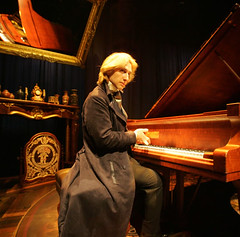
Beethoven, As I Knew Him

Thursday, April 15, 2010
The Boxcar Children
Get ready for fun and adventure as The Laguna Playhouse Youth Theatre brings the cherished children's book The Boxcar Children to life on stage April 23 - 25.Originally written in 1924 by Gertrude Chandler Warner and adapted for the stage in 1999 by Barbara Field, The Boxcar Children tells the story of four orphaned children during the Great Depression. After their parents drown in a boating accident, the children - ages 5 to 14 - run away when they overhear talk of putting them in separate foster homes. With the motto, "we stick together like glue," the children find an abandoned railroad boxcar and turn it into their home.
"The play reiterates the feeling of community and family, and that family sometimes takes different shapes and forms than what we think it's supposed to be," explains director Kelly Herman.
The Boxcar Children also explores the themes of personal integrity, maturity, and making do with what you have. In tough economic times, people begin to appreciate the things in life that cannot be bought, like the generosity and kindness of friends, family and strangers.
"With our current economic situation, it's a reminder that we can make good things happen even when we don't have a lot," says Herman.
According to Herman, this production of The Boxcar Children is being staged as it would have been done in the great depression.
"The actors never leave the stage, and all the music and sound effects are done on stage," she says. "Back in the 1930s, people would say ‘let's do a play!' so that is exactly what we're doing."
Of the play, The Seattle Times said, "Though the central story is the same, Field's script amplifies the psychological and social dimensions of the book considerably. With all the added material, The Boxcar Children has grown into an extended, more instructive and informative tale."
Performance Dates
April 23: 10 a.m. & 7:30 p.m.
April 24: 2 p.m. & 7:30 p.m.
April 25: 1 p.m. & 5:00 p.m.
Ticket Prices
Children: $18
Adults: $20
FOR INFORMATION & TO PURCHASE TICKETS:
CALL: 949.497.ARTS (2787)
GROUP SALES: 949.497.2787 ext. 229
VISIT: http://www.lagunaplayhouse.com/
Saturday, March 20, 2010
Insider's Map to The Second City History
Celebrating over 50 years of funny, Chicago-based improvisational comedy troupe, The Second City, is well known for stirring up snickers with its satirical sketches. It is compiled of 11 full time touring ensembles, performing short scenes, songs and improvisational sketches at venues across the nation.
The Second City has theatres in Chicago and Toronto, as well as training facilities in those cities and Hollywood. The Second City Training Center is the largest school of improvisation and sketch comedy in the world. The "Harvard of humor," as The New York Times calls it, offers acting classes to comedians of all experience levels.
The Second City gained admirable clout in the 1970's when it contributed well-known comedians and alumni Bill Murray and John Belushi to Saturday Night Live television. Today the legend continues with SNL starlets Tiny Fey and Amy Poehler, also former Second City Citizens. Overall, Second City has contributed over two-dozen actors and writers to SNL.
Last December the comedy troupe kicked off its 50th birthday bash with "The Second City Alumni: One Night Only," which featured panel discussions and a series of classic sketches including a piece by Stephen Colbert and Steve Carell.
The Second City: Can You be More Pacific? has been specially crafted for its debut at the Laguna Playhouse. This show promises to deliver an avalance of laughs that will highligh the most comedic and relevant elements of what it means to be behind the Orange Curtain.
Second City Citizens: Alumni of the Second City include...
- Bill Murray
- John Belushi
- Dan Aykroyd
- Tina Fey
- Stephen Colbert
- Alan Arkin
- Gilda Radner
- Steve Carell
- Chris Farley
- Bonnie Hunt
- Mike Meyers
- Amy Sedaris
- Sean Hayes
- Martin Short
- Joan Rivers
- Rachel Draft
For more information on The Second City and to watch videos of The Second City sketches visit http://www.secondcity.com/
Sunday, March 7, 2010
Can You Be More Pacific? at the Laguna Playhouse
CAN YOU BE MORE PACIFIC?
THROUGH APRIL 11 AT THE LAGUNA PLAYHOUSE
LAGUNA BEACH, CA - March 5, 2010 - Get ready for an outrageous evening of laughter when internationally acclaimed sketch-comedy troupe, The Second City, comes to Orange County March 16 - April 11, 2010, with the World Premiere of Can You Be More Pacific?, a custom-crafted production for The Laguna Playhouse that lampoons Laguna Beach and Orange County.
This show promises to deliver an avalanche of laughs that highlight the most comedic and relevant elements of what it means to be behind the Orange Curtain. Whether you're a life-long OC resident or a recent transplant, you'll see yourself, your neighbor or your favorite plastic surgeon lampooned on stage. From real housewives to theme park mania, this California adventure is a wild comedy ride that doesn't require a toll road.
Two Second City writers - Andy Cobb and Marc Warzecha - spent four days in OC soaking up the culture and talking to local celebrities, journalists, newsmakers, and muckrackers about the good, the bad and the ugly in and around OC. They soared over Irvine in the Great Park Balloon, ate tacos from a taco truck in Santa Ana, peered among the pews of the Crystal Cathedral, scoured Surf City, toured Newport Coast and cruised the toll roads.
Now, armed with fresh fodder and a renewed sense of what makes OC such a funny county, Andy and Marc have concocted a crazy sketch comedy show called Can You Be More Pacific? that's guaranteed to keep audiences laughing all night long.
Can You Be More Pacific? is the sixth regional-specific show created by the Second City, and celebrates the comedic troupe's successful 50-year history of zany comedy that has fostered such talented legends as Joh Belushi, Bill Murray, Dan Aykroyd, Gilda Radner, Stephen Colbert, Mike Myers, Amy Poehler, and Tina Fey.
Saturday, March 6, 2010
Two Minutes of Theatre: The Secret Life of Girls
Tuesday, March 2, 2010
The Boxcar Children Audition Notice
Directed by Kelly Herman
Adapted by Barbara Field from the novels by Gertrude Chandler Warner
(For all ages)
One warm night four children stood in front of a bakery. No one knew them. No one knew where they had come from. Henry, Jessie, Violet and Benny are orphaned and in danger of being sent to different foster homes. The four siblings run away and make their home in an abandoned railroad boxcar. Pursued by the authorities and a mysterious stranger, the children discover the rewards and perils of life on the run, as well as the joy of keeping their family together. Youth & Mid-Teen Roles:
• Henry Alden (male) 14 - 16
• Jessie Alden (female) 14 - 16
• Violet Alden (female) 12 - 14
• Benny Alden (male) 10 - 12
• The Kid (male or female) 10 - 12
• Ensemble Children: homeless from Hooverville
Older Teen & Adult Roles:
• Mr. Alden (grandpa of children)/Officer Banning
• Sarah Calder
• Mrs. Alberts/Mrs. Truman (Sam's Mother)/Baker Woman
• Dr. Sam Truman/ Sheriff
• Cookie (male or female)
• Big Mike (male or female)
Prepare: A memorized 1 - 2 minute monologue & bring current photo, resume & conflicts
Schedule:
Auditions:
Friday March 12, 6:00 - 8:00pm
Saturday March 13, 11:00am - 5:00pm
Callbacks: Sunday March 14 (by invitation)
11:30 - 3:30pm Cold Readings
First Rehearsal:
Monday March 15, 7:00pm (Rehearses Eve & Sat)
Tech:
Tues & Wed, Thurs April 20-22 5:00pm - 11:00pm
Production Dates:
April 23 - 26 Weekend Performances & Matinees (7 Performances)
School Day Matinees:
April 23 - 26 Friday & Monday at 10:00am
Please call Wally Ziegler at (949)472-0061
23402 South Pointe Drive, Laguna Hills
Tuesday, February 23, 2010
March Madness at the Laguna Playhouse
Monsieur ChopinFeb 25 - March 7
Performances Thurs- Sat 8pm, Sat & Sun 2pm, Sun 7pm
Did you enjoy George Gershwin Alone? Hershey Felder will be performing the 2nd piece in his 'Composer Sonata' at the Laguna Playhouse. Join us as Frederic Chopin teaches piano lessons from his Paris salon in 1848. With the success of George Gershwin Alone, this event is sure to be a hit. Move quickly- Monsieur Chopin is a limited engagement and is selling quickly!
http://www.lagunaplayhouse.com/onstage/special/monsieur-chopin/
The Secret Life of GirlsMarch 9 - 11
Performances Tuesday - Thursday 7:30pm
Did you know an estimated 160,000 children miss school every day out of fear of attack or intimidation by other students? Parents and teenagers can learn more about the solutions to emotional bullying in schools at a performance of The Secret Life of Girls, part of our Theatre for a New Generation. Aimed for children in middle school and high school, this would be a great opportunity for discussing issues that your young one may face at school.
http://www.lagunaplayhouse.com/education/new-generation/
The Second City: Can You be more Pacific?March 16 - April 11
Performances Tues - Sat 8pm, Sat & Sun 2pm, Sun 7pm (exclud 4/4), Thur 2pm on 3/18 & 4/1
The internationally acclaimed sketch-comedy company, The Second City, has custom crafted a production for The Laguna Playhouse to lampoon our beloved Laguna Beach and Orange County. This show promises to deliver an avalanche of laughs that will highlight the most comedic and relevant elements of what it means to be behind the Orange Curtain.
If you have lived in Orange County for any length of time, you will see yourself, your neighbor or your favorite plastic surgeon highlighted on stage for a good ribbing. From real housewives to finding sand in all the wrong places, this California adventure is a comedy ride that can’t be missed and won’t require a toll road.
http://www.lagunaplayhouse.com/onstage/2010/tba/
Don't forget to add us on twitter @LagunaPlayhouse for daily updates about all our upcoming shows!
Wednesday, January 27, 2010
Hershey Felder brings his "Composer Sonata" to Laguna!
Interested in seeing the "Composer Sonata"? We have a special deal for you! Purchase tickets to two or more of these performances, and we'll give you 20% off your tickets! We'll even wave our normal $4 per ticket processing fee for a one time $4 fee covering all the tickets in your order! That's a potential savings of up to $50 per person!
Jan 12 - Feb 21
Performances Tues - Sat at 8pm
Sat & Sun at 2pm
Saturday, January 23, 2010
Dining Out Tonight?
Two of our staff's favorite restaurants are offering discounts to our audiences as well!
The Lumberyard offers a complimentary dessert when you show them your ticket or ticket stub on the day of your performance! (limit one dessert per party of two) With the Lumberyard only a short walk away, it's a popular place for our audience to grab a bite or get drinks after the show.http://lblumberyard.com/
http://www.nirvanagrille.com/
Spending more time in Laguna? Check out the Laguna Beach Visitors Bureau site for information about local events, hotels, and more!

Monday, January 18, 2010
Hershey Felder as George Gershwin Alone Press Release

Tuesday - Saturday at 8 p.m. / Saturday & Sunday at 2 p.m.
Thursday Matinees January 14 & 28 at 2 p.m.
Sunday Evening January 24 at 7 p.m.
Preview Performances: $35 to $55
Regular Performances: $40 to $70
CALL: (949)497-ARTS (2787)
Wednesday, December 9, 2009
Winter Wonderettes Photos
"Tied neatly with a pretty bow, the show is packaged precisely to induce just the right amount of laughs and to entertain enough to fill its audience with yuletide giddiness"- Broadway World
"The four mildly dysfunctional but lovable women who first entertained playhouse audiences in 2008 with The Marvelous Wonderettes provide the same mix of mid-century pop songs, patter, petty rivalries and minor-league life crises that writer-director Roger Bean gave them the first time around." - Paul Hodgins, OC Register
"What makes a successful musical revue? Look no further than Roger Bean and his Wonderettes, the Marvelous Wonderettes, that is. It's Christmas, so they're the Winter Wonderettes and what sheer heaven!" - Don Grigware
Friday, November 27, 2009
OC Register Interviews Winter Wonderettes Director, Roger Bean
OC Register
November 25, 2009
Over the last few years, Roger Bean's life has been pretty much taken over by four modestly talented female singers who call themselves the Wonderettes.
Bean, a playwright and director, admits that he spends more time than he ever imagined dealing with his fictional creations, who hail from Springfield (Bean chose that hometown because it's the most common name for an American city – he wants the Wonderettes to be from nowhere and everywhere).
"In the last couple of years, my life has mostly been taken up with Wonderettes-related stuff," said Bean, who has spent several weeks preparing "Winter Wonderettes" for a production at the Laguna Playhouse, where it opens Nov. 28. "Recently there have been 'Wonderette' shows in New York and Chicago and Florida and Hawaii."
Last year, local audiences got their first taste of the winsome foursome when the original incarnation of the show, "The Marvelous Wonderettes," played at the Laguna Playhouse.
The Wonderettes are catty, vindictive, backbiting and blithely egotistical. They're also the best of friends who have been performing as close-harmony singers since high school.
The group consists of Missy, the prim, level-headed one, easily the quartet's most talented singer; Cindy Lou, a statuesque beauty with a sultry delivery and that annoying sense of entitlement beautiful people exude; excitable Betty Jean, whose got some creative differences with Cindy Lou; and Suzy, a gum-chewing, lovable bimbo who has a budding romance going with Richie, the guy who runs the show's lights and isn't afraid of demonstrating his luminous love from the tech booth.
"Winter Wonderettes" is a sequel of sorts to "The Marvelous Wonderettes," which begins in 1958 when the four girls are still in high school and ends 10 years later, when life has started to deliver its tribulations and rewards.
"'Winter Wonderettes' takes place about six months after the first play ends," Bean said. "There's a little bit of movement that's happened. You find out that Missy, who got proposed to onstage, has been married. Richie is married to Suzy. She's had twins and she's pregnant again. She's turning into a baby factory."
The story is set in Harper's Hardware, where Betty Jean has worked since high school. The Wonderettes have transformed the drab place into a Yuletide-themed wonderland. Mr. Harper is due to appear at the end of the evening as Santa Claus, as he does every year to hand out everyone's eagerly anticipated Christmas bonus envelope.
But this year, Harper is a no-show. Betty Jean runs off to find him but comes back with the envelopes instead. Everyone opens them to discover not cash but pink slips. Harper's Hardware is closing its doors forever.
"I think everyone will really identify with that part of the show this year," said Bean, who penned "Winter Wonderettes" back in 2003 when unemployment was far less of an issue than it is today.
Bean is quick to reassure us that things aren't as dire as they appear. It was never his intention to delve into heavy issues with the Wonderettes franchise.
"I wanted to steer clear of the weightier things happening at the time. Getting into the Vietnam War, for example, would have been too rough for this little jukebox world I created."
One hallmark of Bean's shows is his use of period music, both popular and obscure, to define the Wonderettes' style and help tell their stories. "Winter Wonderettes" contains traditional Christmas carols, midcentury pop songs that everyone knows and a few not-so-familiar tunes as well: "The Man With the Bag," "Run, Rudolph, Run," "Christmas Will Be Just Another Lonely Day" and "Suzy Snowflake."
"I go through a lot of songs when I put these shows together," Bean said. "I listen to them over and over, and stories begin to take shape. I think, 'I'd love to have this song in the show. Whose story does it fit into?' After many listenings the solution will come to me about how the songs could be part of somebody's story line."
Bean once thought that the success of the Wonderettes would give him a certain amount of free time. No such luck.
"I run my own licensing company now, which looks after the Wonderettes as well as three other shows that are my own. Every once in a while I find a short period to write something new. But the more success I have the busier I get. I used to think, 'When I get to a certain level of success I'll be able to do whatever I want.' But once you create something like this, you spend a lot of your time maintaining it."
Tuesday, November 10, 2009
Coastline Pilot Stuart Little Preview
Preview by Tom Titus
November 5, 2009
There’s a mouse in the house this weekend and next — very old mouse actually, born in 1945 as a literary cousin of Charlotte the barnyard spider.“Stuart Little: A Musical Fantasy” is the Laguna Playhouse’s youth theater production, opening tonight for a two-weekend engagement as the latest incarnation of the story created at the end of World War II by E.B. White, best known for the children’s classic “Charlotte’s Web.”
Stuart, as most kids (and many adults) are aware, is a little mouse, just two inches tall, who’s “born” into the Frederick C. Little family in New York. He’s a determined underdog trying to survive in a real people’s world.
“Yes, ‘Stuart Little’ is now a musical,” says Donna Inglima, director of the playhouse’s Youth Theater, who’s staging the production. “It should come as no surprise that this beloved story would be made into a play (in 1973) and then into a musical.”
The White book has been adapted by Joseph Robinette, with music by Ronna Frank.
“The Laguna Playhouse Youth Theater is fortunate to get the rights to produce this ‘cuter than a mouse’ piece of delicious storytelling that features absolutely adorable songs and crazy characters,” the director adds.
“It’s also interesting to note that E.B. White has written a story that’s immersed in a world that combines human and animal interaction long before Gary Larson’s (Far Side) cartoon strips became so prevalent and popular,” Inglima said.
As is the case with all youth theater productions at the playhouse, “Stuart Little” will receive a full professional staging. This show is one of a two-play subscription series of plays and musicals based on popular books or stories aimed primarily for children of elementary and middle school ages.
“The staff for each production is drawn principally from the playhouse’s Youth Conservatory Program,” Inglima explains. “Open casting is ‘age-appropriate,’ which means that young people play young people in the plays with content similar to G or PG-rated movies.”
Youngsters (and their parents) attending “Stuart Little” this weekend and next will be treated to musical numbers such as “Paddle Your Own Canoe,” “Feed Him Up,” “Size” and “Nighttime in New York.”
The latter is sang by a quartet of cats.
http://www.coastlinepilot.com/articles/2009/11/06/blogs_and_columns/on_theatre/cpt-titus110609.txt
Monday, November 9, 2009
2 Minutes of Theater: Winter Wonderttes Rehearsal
Wonderettes cast includes Bets Malone, Misty Cotton, Julie Dixon Jackson and Susannah Hall. Meghan, our host, is the girl behind this blog and many of our tweets on twitter! Thanks to Chris Trela, the Director of Communications, for the idea, filming, and editing!
Tuesday, November 3, 2009
Laguna Playhouse Celebrates 89!
What was it like working with Clark Gable and Vivien Leigh?
Thursday, October 22, 2009
Stage Scene LA Review
Playwright Ron Hutchinson imagines what might have happened behind those closed doors in his hit comedy Moonlight And Magnolias, now getting its first L.A./Orange County big stage production at the Laguna Playhouse (moving to the La Mirada Theatre For The Performing Arts in November). Blessed with Andrew Barnicle’s expert direction, sensational performances by Jeff Marlow (Selznick), Brendan Ford (Fleming), Leonard Kelly-Young (Hecht), and Emily Eiden (harried secretary Miss Poppenghul), and an absolutely gorgeous set designed by Bruce Goodrich, Moonlight And Magnolias is a show which will delight, entertain, and elucidate anyone who’s ever seen GWTW, and that’s just about everyone on the planet, right?
At lights up, Selznick has just shut down production on the movie, Sidney Howard’s script having proved unfilmable, and called in Hecht, screenwriter of Wuthering Heights, Nothing Sacred, Design For Living, and uncredited scribe of countless more movies in need of doctoring. The head of Selznick International Pictures has also fired director George Cukor and summoned Fleming to take over filming, despite the fact that Fleming still has two more weeks left on The Wizard Of Oz. Fleming, under contract to GWTW distributor MGM, has no choice but to acquiesce. Hecht, on the other hand, takes quite a bit more persuading—and $15,000 (about $225,000 today!) for his five days of work.
Since Hecht hardly has time to read the novel’s more than 1000 pages, Selznick has Fleming help him reenact the book’s key scenes, with the very macho Fleming portraying both Melanie and Prissy, and Hecht typing like a demon. As the hours and days pass, the men become more and more harried, the office gets messier and messier, and Miss Poppinghul’s hair takes on a life of its own. For audiences at the Laguna Playhouse, the result is some of the most hysterical physical comedy of the season, and a priceless lesson in Hollywood history.
In the 1930s it was common practice for screenwriters to change whatever they saw fit when adapting novels for the screen, and Hecht wants to change both the book’s setting and its time period (no Civil War movie ever having made money). Selznick, however, is adamant—Gone With The Wind will stick to Mitchell’s plot (and dialog), even if it means having an immoral hero and heroine and no romantic fadeout for Scarlett and Rhett. Then there’s the matter of the slap Scarlett gives to Prissy when the slave girl returns without a doctor in tow to the room where Melanie is about to give birth. Hecht imagines the slave girl giving an impassioned anti-slavery speech, and you can imagine how that would go off in 1930s America, especially in the still segregated South.
Besides the sheer entertainment value of Hutchinson’s script and the fly-on-the-wall sensation of being witness to Hollywood history, Moonlight And Magnolias also provides a glimpse of a time not quite so “golden” as social conservatives would have us believe. Not only “Negroes” are second-class citizens in 1930s Hollywood. Even Tinseltown’s uber-powerful studio heads find themselves unable to buy homes in upscale Hancock Park, nor can their bank accounts buy them memberships in the “best” country clubs, as Selznick finds out when Hecht telephones WASP producer Nunnally Johnson with a simple question, “David O. Selznick...American or Jew?” Guess what Johnson replies, as do the two other All-American power players Hecht phones?
Still, politics aside, Moonlight And Magnolias is mostly just great, entertaining fun, and some of the best acted fun you’ll see this or any month. The always marvelous Marlowe adds Selznick to the list of nebbishes he’s so masterful at embodying. Kelly-Young is perfection as the increasingly frazzled Hecht, and a master of the sarcastic retort to boot. Ford is a great, handsome, macho Fleming, his easy masculinity making his female impersonations all the funnier. Eiden makes the simple line “Yes, Mr. Selznick” worth its weight in gold. Rarely has an actress made so much out of so little to such hilarious effect.
Goodrich’s set is so elegant with its wood paneling, art deco wall engravings, and plush leather sofa and armchairs that it could have been transported directly from 1939 MGM to the Laguna Beach playhouse. Top marks too to Julie Keen’s period costumes, Paulie Jenkins lighting (especially for the way she lights the skyline seen through the office’s big picture windows), and Julie Ferrin’s sound design.
Having now seen Moonlight And Magnolias, I’m eager to get my hands on a Gone With The Wind DVD and re-experience one of the greatest films of all time. I know that from the opening notes of Max Steiner’s score to Scarlett’s “Tomorrow is another day!”, my viewing experience will be that much richer for having been inside Selznick’s office those five fateful days.
Tuesday, October 20, 2009
Critics Rave About Moonlight & Magnolias!
In Andrew Barnicle's riotous staging of the 2004 play at Laguna Playhouse, we're invited to examine both the hilarity and the drama of a Hollywood mogul acutely aware of the many figures nipping at his heels, from gossip columnists to rival producers," writes Eric Marchese in the OC Register. "The actions of the play's trio of stars plays like vintage screwball comedy from the 1930s and '40s, with plenty of scurrying about, shouting, hurtling insults and snappy comebacks, slapping, mugging and more. Despite the lack of traditional action, Barnicle and his cast, though, keep things fresh. In a relatively small role, even Emily Eiden, as Selznick's yes-girl, garners laughs with her rote recitation of the line "Yes Mr. Selznick," her response to nearly his every question or command. Read the complete OC Register review!
In the Event News, Joseph Sirota calls the play "a barn-burning crowd pleaser. This smashingly tasty production at the Laguna Playhouse satisfies our curiosity while bringing us two hours of non-stop smiles and laughter. Also enlightening and insightful, it smartly examines what truly drives gifted, high-achievers we salute. Hat's off to the amazingly funny, yet movingly 'human' four cast members who deliver this immensely demanding play with perfection: Jeff Marlow as dazzlingly driven to win-or-die Selznick, Leonard Kelly-Young as Hecht, master screenwriter with an underlying philosopher's soul, Brendan Ford as Fleming, tough, hardworking street kid-- turned Hollywood director and Emily Eiden as Miss P, cute exec-assistant, working to a frazzle to support these crazed guys rescuing the film."
"Exquisitely directed by Andrew Barnicle," notes Ben Miles in the Riverside Press Enterprise . "Jeff Marlow portrays David O. Selznick with biographical exactitude. Completely convincing in each moment of his characterization, Marlow's incarnation of Selznick is a pinched-nerve of a performance, replete with energetic neurosis. As Ben Hecht, Leonard Kelly-Young is a cynical, dry-witted delight. In one instance, Kelly-Young is convulsed in laughter; it is so genuine a moment that the guffaws quickly become contagious. Brendan Ford plays auteur Victor Fleming as a forceful lug. It's easy to envision Ford's Fleming as a Bligh-like tyrant on the sound stage. After all, Fleming was accused of slapping the young Judy Garland. Also, Emily Eiden, as Selznick's secretary, Miss Poppenghul, has several wonderful moments of comic naturalism. What's more, with Bruce Goodrich's convincing 1930s office setting, Julie Ferrin's rich sound-scape, as well as Paulie Jenkins's lighting design and Julie Keen's spot-on costuming, The Laguna Playhouse provides for us an entertaining and informative staging of this enjoyable show."
Monday, October 19, 2009
Tuesday, October 13, 2009
Gone With the Wind- Behind the Scenes
Compiled & edited by Christopher Trela
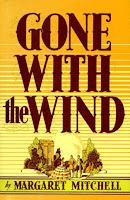
Few books captured the imagination of our nation like Gone with the Wind. The only novel written by Margaret Mitchell, Gone with the Wind is set during the American Civil War and Reconstruction. It follows the story of Scarlett O’Hara, the daughter of an Irish immigrant plantation owner, as she pursues romance and endures the hardships of war.
The novel won the 1937 Pulitzer Prize and was adapted into an Academy Award-winning 1939 film of the same name. It was also adapted during the 1970s into a stage musical called Scarlett, and a new musical stage adaptation (titled Gone With The Wind) played in
It took Mitchell seven years to write the book and a further eight months to check the thousands of historical and social references. The title is taken from the first line of the third stanza of the poem Non Sum Qualis eram Bonae Sub Regno Cynarae by Ernest Dowson: "I have forgot much, Cynara! gone with the wind." Scarlett O'Hara uses the title phrase when she wonders if her home, a plantation called Tara, is still standing, or if it was "also gone with the wind which had swept through
The novel was almost titled after the final line in the book, "Tomorrow is another day," but there were several books at that time close to the same title, so Mitchell selected a new title: Gone with the Wind.
Gone with the Wind is one of the most popular books of all time, selling more than 30 million copies. Time magazine included the novel in its 100 Best English-language Novels from 1923 to 2005.
FROM BOOK TO FILM

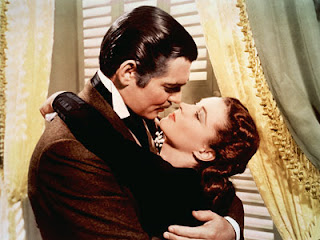
Directed by Victor Fleming (who replaced George Cukor), the epic movie version of Gone with the Wind stars Clark Gable, Vivien Leigh, Leslie Howard, and Olivia de Havilland.
Gone with the Wind received ten Academy Awards, a record that stood for twenty years. In the American Film Institute's inaugural Top 100 American Films of All Time list of 1998, it was ranked number four, although in the 10th Anniversary edition of that list in 2007, it dropped two places to number six. Rhett Butler’s (Clark Gable) farewell line to Scarlett O’Hara (Vivien Leigh), “Frankly, my dear, I don’t give a damn,” was voted in a poll by the American Film Institute in 2005 as the most memorable line in cinema history.
The movie has sold more tickets in the
BEHIND THE SCENES

Selznick replaced the film's director three weeks into filming and then had the script rewritten. He sought out director Victor Fleming, who, at the time, was directing The Wizard of Oz. Fleming was dissatisfied with the script, so Selznick brought in famed writer Ben Hecht (who was working on the Marx Brothers’ comedy At The Circus) to rewrite the entire screenplay within five days.Original Gone with the Wind screenplay writer Sidney Howard’s first submission was far too long and would have clocked in at six hours. Producer David O. Selznick wanted Howard to be on the set to make revisions, but Howard refused to leave
By the time of the film's release, there was some question as to who should receive screen credit, but despite the number of writers and changes, the final script was close to Howard's version. Howard's name alone appears on the credits, possibly a salute to his memory as well as his writing, because Howard died tragically at age 48 in a farm tractor accident prior to the movie's premiere.
The casting of the two lead roles became a complex, two-year endeavor. Many famous or soon-to-be-famous actresses were either screen-tested, auditioned, or considered for the role of Scarlett, including Jean Arthur, Lucille Ball, Tallulah Bankhead, Joan Bennett, Joan Crawford, Bette Davis, Frances Dee, Olivia de Havilland, Irene Dunne, Joan Fontaine, Greer Garson, Paulette Goddard, Susan Hayward, Katharine Hepburn, Miriam Hopkins, Carole Lombard, Ida Lupino, Merle Oberon, Norma Shearer, Barbara Stanwyck, Margaret Sullavan, Lana Turner and Loretta Young.
For the role of Rhett Butler, Clark Gable was an almost immediate favorite, although other actors under consideration were Gary Cooper and Errol Flynn.
Principal photography began January 26, 1939, and ended on June 27, 1939, with post-production work concluding on November 11, 1939. Director George Cukor, with whom Selznick had a long working relationship, and who had spent almost two years in preproduction on Gone with the Wind, was replaced after less than three weeks of shooting. Olivia de Havilland said that she learned of George Cukor's firing from Vivien Leigh on the day the
Cinematographer Lee Garmes began the production, but after a month of shooting what Selznick and his associates thought was "too dark" footage, was replaced with Ernest Haller, working with Technicolor cinematographer Ray Rennahan. Most of the filming was done on "the back forty" of Selznick International studio. The location scenes were photographed primarily in
OPENING NIGHT

On September 9, 1939, Selznick, his wife Irene Mayer Selznick, investor Jock Whitney, and film editor Hal Kern drove out to
When the film began, there was a buzz in the audience when Selznick's name appeared, as audiences had been reading about the making of the film for the past two years. In an interview years later, Kern described the exact moment the audience realized what was happening by stating “when Margaret Mitchell's name came on the screen, you never heard such a sound in your life. They just yelled, they stood up on the seats...and when the title Gone with the Wind came on the screen, it was thunderous!”
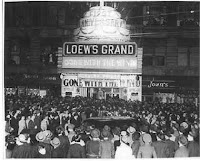
The film premiered in Atlanta, Georgia, on December 15, 1939, as the climax of three days of festivities that included a parade of limousines featuring stars from the film, receptions, thousands of Confederate flags, false antebellum fronts on stores and homes, and a costume ball. Eurith D. Rivers, the governor of
LEGACY
Gone with the Wind was given theatrical re-releases in 1947, 1954 (widescreen), 1961, 1967 (70 mm stereophonic), 1971, 1989, and 1998. The film made its television debut on the HBO cable network in June 1976, and its broadcast TV debut in November of that year in two parts on the NBC network, where it became at that time the highest-rated television program ever presented on a single network, watched by 47.5 percent of the households sampled in America, and 65 percent of television viewers. Ironically, it was surpassed the following year by the mini-series Roots, a saga about slavery in
In 1989, Gone with the Wind was selected for preservation in the United States National Film Registry by the Library of Congress as being "culturally, historically, or aesthetically significant."
Tuesday, October 6, 2009
Interview with Moonlight and Magnolias Director, Andy Barnicle

A: I saw the premiere at the Old Globe in
Q: This is based on real characters and a real situation. What challenge does this pose on you and the actors as far as being authentic to history?
A: The play is actually

Q: How much research on the real life people involved in this play will you and the actors do? Will there be a group screening of GWTW for actors and crew?
A: I have read whatever biographies and auto-biographies exist about these characters. I suspect that I have retraced
Q: The play reads at times like a rapid fire Marx Brothers-style movie, and the overall feel is very comic. How difficult is it to stage/direct this kind of play?
A: The difficult task here is to stage the farcical moments in balance with, or outgrowths of, the serious ideas. Creating comedy that seems possible will allow the motivational forces behind these real people to manifest themselves. If we go too far in either direction we will have a problem--a really slick farce that doesn't allow for the human urges underneath, or a too serious play that has occasional bizarre and unlikely behavior in it. All in all, the theory is to find out who the people are and what they want in order to justify the extreme behavior. These men have needs so great, and there is so much at stake, that they are driven to extreme behavior. If this extreme behavior gets disconnected from its need to exist however, what results are cartoon characters who are difficult to invest in.